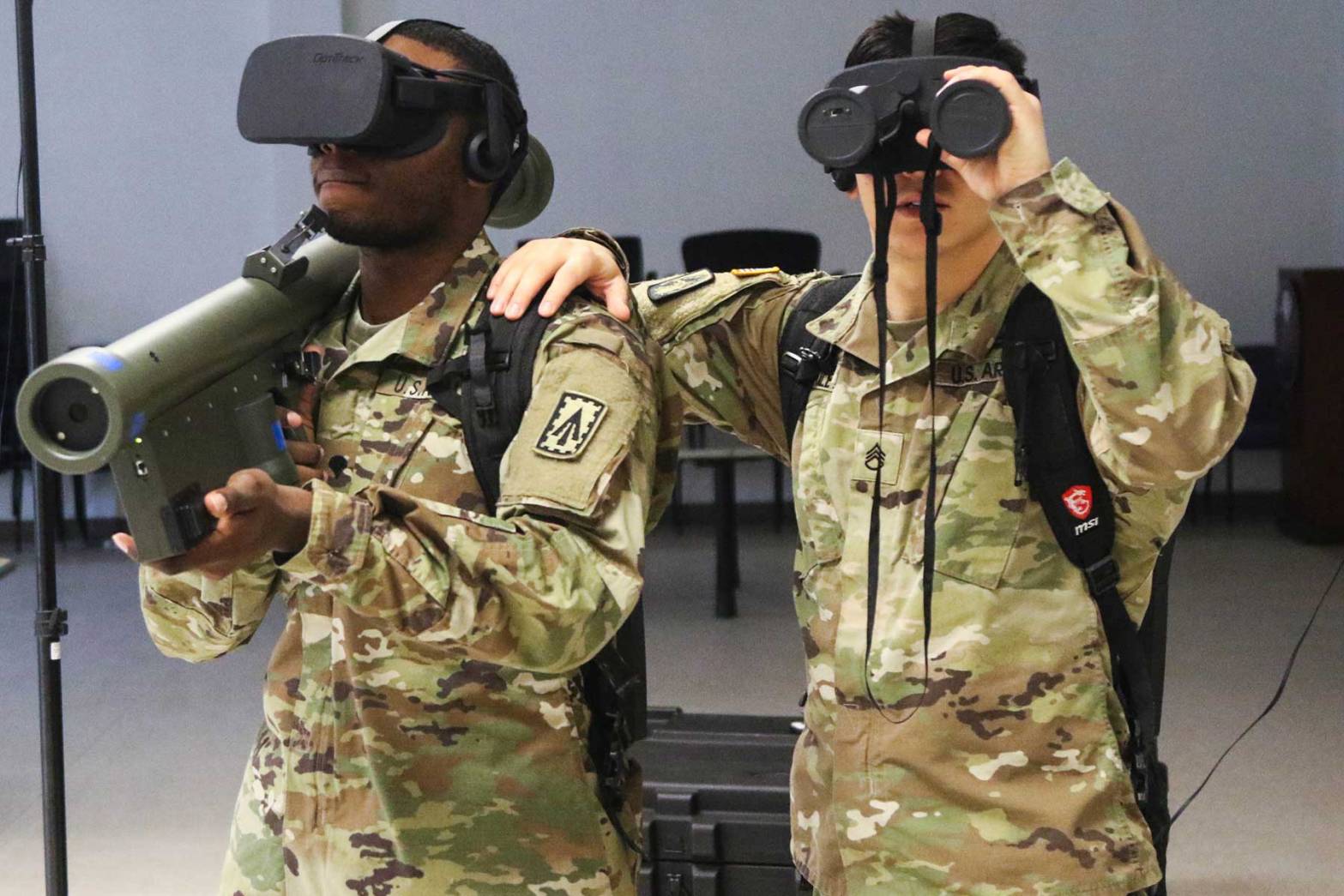
The military and government are perhaps some of the earliest adopters of virtual and augmented reality technology. Branches of each military are seeking ways to use the technology to increase the effectiveness of its soldiers, to train them, and to care for them. The technology has allowed for the development of numerous applications with unique functions.
Helicopter pilots, tank drivers, fighter pilots, and more have been making use of the technology for decades now. For instance, Rockwell Collins developed a highly advanced head mounted display/guidance systems for the F-35 fighter plane that combines a number of function like a head down display, night vision, a technology called AMTI processing which allows the system to detect movement such as a convoy of enemy trucks moving below, and FLIR which allows the pilot to zoom in and lock on to targets, among others. The video below provides an in depth overview of the pilot’s system and an example of its application.
The next video provides a higher quality version of a display system that pilots might use to check their altitude, speed, compass, and more.
The military also has been using the technology extensively to train soldiers for unique and often times dangerous situations such as combat, parachuting, medical aid during combat, flight simulation, and much more. Most notably, combat and flight training are used by the technology to reduce the cost of training and to simulate a number of stressful combat situations. Howstuffworks offers an in-depth look at the various simulators that the military uses to train its soldiers, marines, airmen, and sailors.
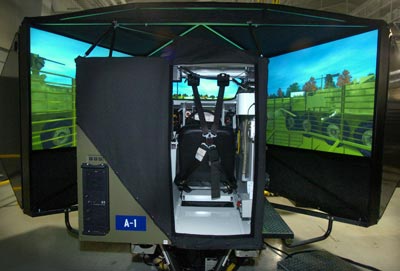
The photo above is an example of how the Army might simulate training for an armored vehicle like the STRYKER. Like flight simulation, ground vehicle training offers the users haptic feedback, accurate consoles and heads up displays, and can create any type of environment needed, allowing soldiers to train on rocky roads, dry deserts, heavy rain in the jungle, and more.
The video below, made by the U.S. Army, exemplifies the various types of training that soldiers might undergo, both physical and virtual, and the technology used to aid the trainees in adopting new skills or polishing old ones.
However, virtual and augmented reality don’t open the door for just training. The technology is now being used in the rehabilitation of military with PTSD. A two-year study conducted by Cardiff University used virtual reality to help 41 veterans try to overcome their PTSD by having them walk on a treadmill towards the stress inducing event that might be their trigger. While the therapy seems almost cruel, many participants, including Matt Neve, the main subject of the article, found that the therapy actually helped them get over their trigger and process the event in a way that abates their PTSD induced episodes. While the therapy isn’t 100% effective, two thirds saw an improvement of 37%, and it doesn’t get rid of all of the symptoms, veterans that participated in the study found that it helped them approach the topic. Neve states, “You want to forget about it, but the only way of forgetting about it is by dealing with it,” which is exactly what the program aims to do. Likewise, a 1997 Georgia Tech study had 10 veterans of the Vietnam War take part in a simulation using VR that would put them in different situations relevant to the war. They would be transported to jungles, helicopters, and more during which a therapist would manipulate the environment and events to replicate what they might have experienced, albeit with less detail. However, all ten patients showed improvement after just a month of treatment. The technology is definitely not surefire and won’t get rid of all symptoms, but each step is a step in the right direction, and for many veterans with PTSD, it will be their first.
 Our Future Reality: Virtual and Augmented