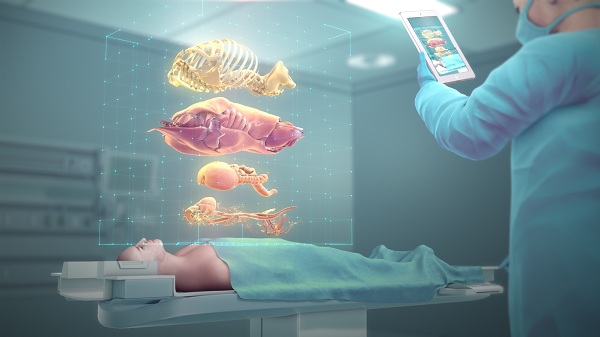
While the image above may seem like it might’ve come out of a science fiction movie there is technology out there that makes this image a possibility. In just the past decade virtual and augmented reality capabilities have grown immensely and the technology has become a lot cheaper as a whole. It has been found to be useful across a number of different sectors with healthcare being no exception. In fact, the healthcare industry as a whole has much to benefit from the use of VR and AR. A number of companies have begun to put together VR and AR products that allow healthcare practitioners to train with a variety of tools in countless unique situation. One company, https://www.simxar.com/, for instance has developed a tool that allows professionals to undergo a number of different simulations under different circumstances that can vary from something as simple as the common cold to caring for someone that requires multiple amputations.
Another company, OSSimTech offers some of the most advanced virtual and augmented reality training there is on the market. The technology allows students to undertake simple to complex procedures, returning haptic feedback and high definition imagery depicting the body. This is especially important today as residency programs are offering less on site training and might not have access to newer procedures and machinery that the students might encounter in the real world. This technology utilizes actual instruments used for surgery so that students may familiarize themselves with the simple tools until they are comfortable to handle more complex tasks with complicated machinery that they might’ve never come across until they begin their actual fellowships. This allows them to develop modern techniques that are ever changing so that they are comfortable once they’re over the knife in real life. It’s a super interesting video and I can’t recommend it enough. It really shows the capabilities of AR when coupled with proprietary machinery.
While this sounds like it might be an impractical way for a professional to learn how to care for someone it offers a number of advantages over other traditional training. Firstly, this allows people to train from anywhere they have the device, room, and internet. This might allow people to practice from home, allowing for more hours of training. Secondly, this allows people to train to handle a circumstance that is not easily simulated. For instance, the current COVID-19 epidemic is a perfect example of a situation that someone might want to try train for without having to come in contact with highly contagious patients. This technology could also be programmed to simulate circumstances that we haven’t faced yet such as an evenly deadlier virus with more complicated symptoms, requiring an entirely different approach to the training. Nevertheless, the technology allows healthcare professionals to take advantage of simulations for training and the vast amounts of information regarding different diseases, procedures, injuries, and more.
 Our Future Reality: Virtual and Augmented