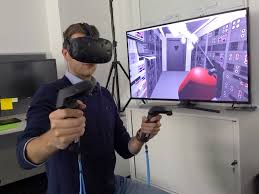
Have you ever wondered what video games could be like if you could just use your physical body to perform a task instead of just buttons and joysticks? Virtual reality is making that a reality.
Virtual reality is a technology that allows users to “physically” interact with digitally created environment using controllers and sensors. Someone with this equipment and software can now interact with a virtual 3D environment in a three dimensional space. You can kneel down and reach out to pick something up in a game, using a button or gripping the controller to actually grab it. While the technology doesn’t allow us to interact with a digital environment without controllers, we still are well on our way to games and applications that can mimic specific actions and environments.
Why is this important?
- While virtual reality from the onset seems to have been driven by gaming and entertainment purposes, the technology has a lot of uses across various sectors.
- Healthcare practitioners can use the technology to aid Alzheimer patients, individuals with dementia, and other mental or physical ailments.
- Militaries can use it to train new soldiers, pilots, programmers, boat operators, tank drivers, and a multitude of other positions that require unique and sensitive training.
- Travel agencies and real estate agents can create 3D videos that allow prospective buyers or travelers to see a particular house, building, or area from the comfort of their homes.
- Businesses can create online modules on their website that allow a user to virtually see a product in a 3D space so that they might be more confident before purchase.
As you can see, virtual reality is a viable technology for a number of different applications across many different fields. In fact, I think it’s well on its way to becoming a general purpose technology or at least disruptive technology. Like other GPT’s before it such as electricity and the steam engine, virtual reality is opening a new door for people across the world to explore their interests in a new digital format. However, as much of the world doesn’t have the access to the technology yet, it can’t be labeled a GPT. Nonetheless, the technology will likely become a disruption in some regard just as the mobile app boomed in the early 2010’s and disrupted the market, creating a new, widely-adopted platform for people to interact with programs, create content, explore the web, and a number of different functions. Likewise, as virtual reality progresses there is a good chance that the technology is adopted by various groups for various purposes. These purposes will more likely than not be consumer related and so the technology will either be adopted or forced on the user until they are comfortable with the technology and then begin to use it. Just as most companies now have people working on the development of mobile formats and applications, these same companies may soon invest in recruiting people with VR skills which may give them an edge over the competition. If done right, VR and AR (augmented reality) have the potential to be a newly adopted medium for looking at products, places, information, games, and more.
On this website I will be covering information regarding the development of technology across five relevant and important sectors:
- Education
- Military
- Business
- Entertainment
- Healthcare
I believe that covering topics or information related to these sectors will provide great, detailed context as to how virtual reality is slowly seeping into our lives and culture, but also how it got there and where it will go from here.
 Our Future Reality: Virtual and Augmented